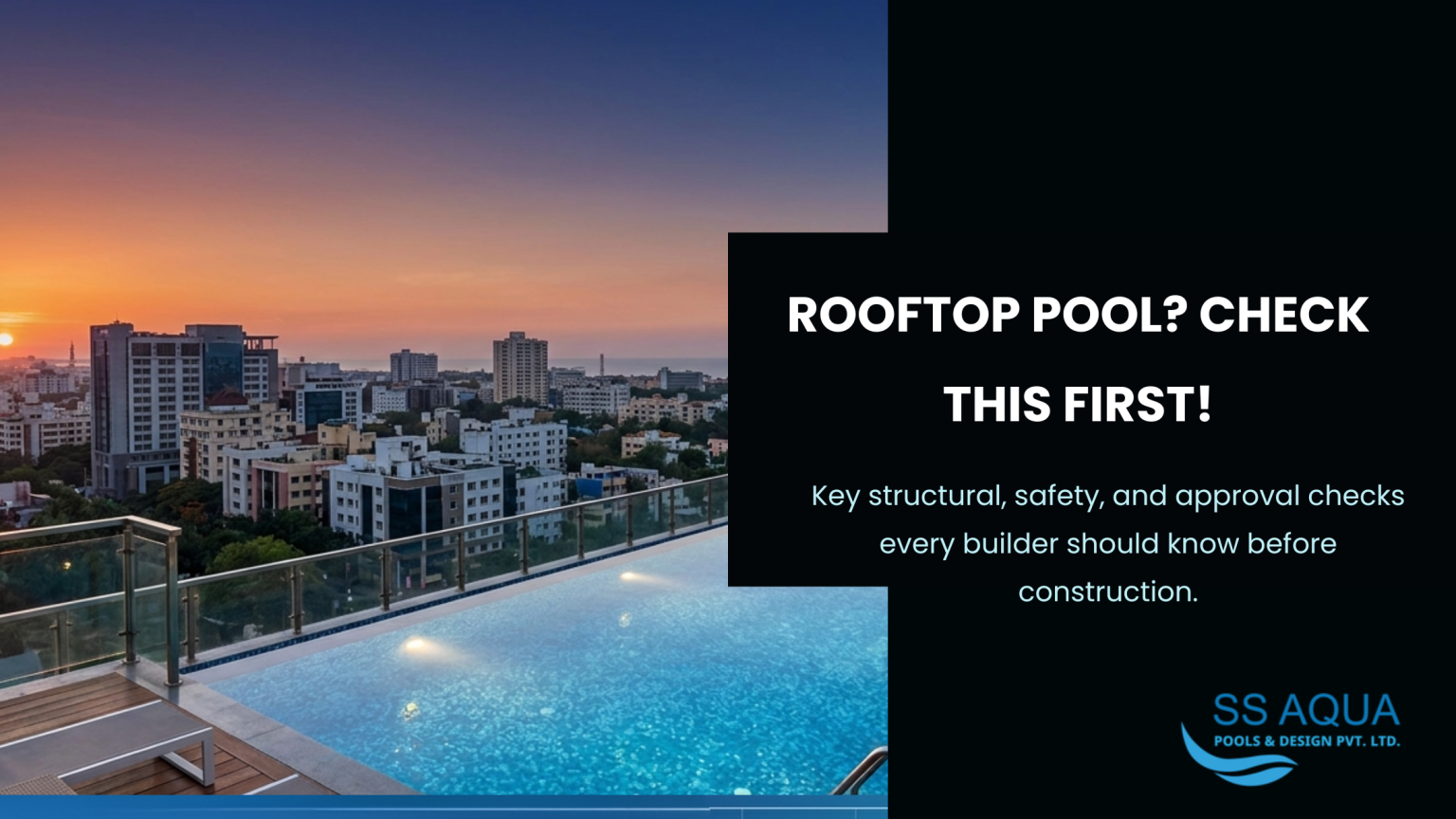
If you are a builder or developer planning a rooftop swimming pool in Chennai, you will definitely need formal approval, and it starts with a structural assessment, not with pool design. Rooftop pools carry weight, water, and equipment loads that most terraces were never designed for. Before you finalize a layout, sign a contract, or promise a client with a skyline view, you need to know whether the building can legally and structurally carry it.
This guide walks builders through exactly what to check, structurally, procedurally, and technically, before a rooftop swimming pool in Chennai gets anywhere near approval. If you are evaluating a rooftop pool Chennai project for a client, treat this as your pre-design checklist.
Do Rooftop Swimming Pools Need Approval in Chennai?
Yes. Any rooftop swimming pool in Chennai requires approval because it changes the structural loading, waterproofing scope, and utility layout of the building. Depending on the project, this can involve
- The local planning authority (Greater Chennai Corporation or CMDA, depending on jurisdiction),
- A licensed structural engineer’s certification,
- NOCs if the pool sits above a certain floor count.
This is precisely why rooftop pool approval Chennai timelines depend so heavily on the structural audit stage, approval bodies want to see engineering sign-off before anything else. Skipping this step is not just a compliance risk, it is a safety risk.
Note:
A pool holds thousands of litres of water, and even a small design gap in load calculation can translate into cracking, leakage, or worse, structural distress over time. Builders who treat rooftop pool approval as a formality rather than an engineering process are the ones who run into rework, penalties, or stalled handovers later.
Can an Existing Building Support a Rooftop Pool?
This is the question every builder asks first. Whether an existing structure can support a rooftop swimming pool in Chennai depends entirely on the building’s original design, not on its age or appearance alone. A few factors that determine this:
- Original design load: Was the terrace designed only for utility use (water tanks, maintenance access), or was extra live-load capacity built in?
- Column and beam layout: Pools concentrate load along specific lines. The existing column grid may or may not align well with a pool’s footprint.
- Foundation capacity: Added dead and live load from a pool eventually transfers down to the foundation. Older buildings were not always designed with this margin.
- Structural condition: Age-related wear, prior modifications, or undocumented changes can all affect capacity, even in buildings that look structurally sound.
There is no generic safe-load figure that applies across buildings, this is precisely why a qualified structural engineer needs to physically assess the building, review original drawings where available, and run the calculations specific to that site.
Note:
Any rooftop pool builder in Chennai who quotes a blanket “this roof can take X load” without a site-specific assessment is skipping a step that protects both the client and the project.
What Structural Checks Are Required for a Rooftop Swimming Pool?
Every rooftop swimming pool construction Chennai project typically requires the following structural checks before design can proceed:
- Load-bearing capacity assessment by a licensed structural engineer, based on actual site conditions
- Suspended slab design: Most rooftop pools sit on a purpose-built suspended structure rather than the existing terrace slab
- Load distribution analysis across columns, beams, and the foundation
- Wind load and lateral force checks, relevant for Chennai’s coastal exposure and cyclone-prone weather patterns
- Seismic considerations, as applicable under the National Building Code
- Deflection and crack-control checks for the pool shell and surrounding slab
This is also where rooftop pool structural requirements and rooftop pool structural design decisions get finalized together, the shape, depth, and position of the pool all feed back into what the structure needs to support.
Builders who lock in a pool design before structural sign-off often end up redesigning later, which costs more time than doing it in the right order.
10-Point Checklist Before Building a Rooftop Swimming Pool
Builders searching for swimming pool approval Chennai requirements usually want one thing: a clear list, not a legal document. Use this as a working checklist for any rooftop swimming pool in Chennai, from initial site assessment through to handover.
Here’s the checklist rewritten in heading-and-content format:
1. Structural Load Assessment by a Licensed Engineer
Confirms the building can carry the combined weight of the pool, water, and equipment load.
2. Suspended Slab / Structural Design Certification
Pools need purpose-built support, not the existing terrace slab.
3. Waterproofing System Selection and Detailing
Prevents leakage into the structure below.
4. Drainage and Overflow Planning
Manages backwash, rain overflow, and filter discharge.
5. Filtration System Sizing and Placement
Keeps water quality safe and equipment accessible.
6. Electrical Safety Planning
Pumps, lighting, and heaters near water need isolated, protected circuits.
7. Access and Safety Railing Design
Terrace-level pools need compliant access points and fall protection.
8. Equipment Room Planning
Filtration, pumps, and chemical dosing need a dedicated, ventilated space.
9. Local Authority Approval and NOCs
Legal sign-off before construction begins.
10. Maintenance Access and Long-Term Upkeep Plan
Rooftop pools need easier access for regular servicing than ground-level pools.
Each of these ties back into the overall rooftop pool approval process in Chennai. If skipping any one item is usually what causes delays at the inspection stage.
Approval Workflow for Rooftop Pools in Chennai
Getting swimming pool approval in Chennai for a rooftop project generally follows this sequence:
- Preliminary structural audit of the existing building by a licensed structural engineer
- Feasibility confirmation — engineer certifies whether the structure can support the proposed pool, with or without reinforcement
- Structural design and drawings prepared for the suspended pool slab, reinforcement, and load paths
- Architect and engineer sign-off on combined structural and waterproofing drawings
- Submission to the relevant local authority for approval, along with structural certification
- NOC collection, if applicable, for fire safety or utility clearances
- Construction execution, following approved drawings exactly, deviations at this stage are a common cause of failed inspections
- Final inspection and handover, including waterproofing and leak testing before the pool is filled for use
- Structural waterproofing membrane applied to the pool shell before tiling or finishing
- Joint and expansion treatment at every junction where the pool structure meets the building
- Double-layer protection in high-risk zones, such as pipe penetrations and drain outlets
- Water ponding tests conducted before the pool is finished, to catch leaks while they’re still repairable
- Periodic re-inspection of waterproofing integrity as part of long-term maintenance, not just at handover
This is the same approval workflow every rooftop pool builders Chennai team should be following, regardless of building size or pool scale.
What Permissions Are Required for a Swimming Pool in Tamil Nadu?
Swimming pool permission Tamil Nadu requirements typically include structural certification from a licensed engineer, approval from the local planning authority (Greater Chennai Corporation or CMDA depending on location), and, for larger or commercial rooftop projects, additional NOCs covering fire safety and water/utility compliance.
Requirements can vary by project scale, building height, and location, so builders should always confirm the exact requirements with the relevant authority before starting construction, this guide is not a substitute for that confirmation.
How Do You Waterproof a Rooftop Swimming Pool?
Rooftop pool waterproofing is one of the most critical, and most commonly under-specified which are the main factors of the entire project. Because the pool sits directly above occupied floors, any waterproofing failure does not just mean pool water loss; it means water damage to the structure and spaces below.
A proper approach typically includes:
Terrace swimming pool construction projects that skip ponding tests are the ones most likely to show leakage issues months after completion, by which point repairs mean cutting into finished work.
Drainage, Filtration and Equipment Room Planning
A suspended swimming pool needs drainage planning that accounts for more than just the pool itself, rainwater overflow, backwash discharge, and filter maintenance all need a clear path off the roof without affecting waterproofing elsewhere.
Filtration systems for rooftop installations should be sized for the pool’s volume and usage pattern, and positioned for easy access; climbing over a sidewall to service a pump is not a workable long-term solution.
This is why equipment room planning matters early, not as an afterthought: a dedicated, ventilated equipment room keeps pumps, filters, and dosing systems protected from weather while staying accessible for routine servicing.
Electrical Safety for Rooftop Pools
Pumps, filtration units, underwater lighting, and heaters all involve electrical components working near water, at height, and exposed to weather, a combination that demands isolated circuits, proper earthing, and weatherproof fittings as standard, not optional upgrades.
Electrical planning should be finalized alongside structural and waterproofing design, not bolted on at the end.
Access and Maintenance Planning
Rooftop pools need safe, code-compliant access, proper staircases or lift access, secure railings, and non-slip surfacing around the pool edge.
Maintenance planning matters just as much: rooftop equipment rooms and filtration systems need to be reachable without disrupting residents or building operations, and a realistic servicing schedule should be part of the handover documentation, not something worked out after the pool is already in use.
SS Aqua’s Role in Rooftop Pool Projects
At SS Aqua, we work directly with builders and developers across Chennai on rooftop swimming pool projects, from structural coordination through to filtration and finishing. We do not just supply pool systems, we work alongside your structural engineer to make sure the pool design, waterproofing, and equipment planning align with what the building can actually support.
Our team has handled rooftop and terrace pool installations across a range of building types in Chennai, and we know the difference between a design that looks good on paper and one that performs for years without leaks or structural concerns.
If you are a builder evaluating a rooftop swimming pool in Chennai for an upcoming project, we can help you assess feasibility early, before design commitments are made that are expensive to unwind later. We have also supported top builders across the city at every stage of a rooftop swimming pool in Chennai, from the first structural conversation to final handover.
Final Words
A rooftop swimming pool in Chennai only succeeds when structure, waterproofing, and approvals align from day one. Skipping the engineering step costs far more than doing it right the first time. Plan early, involve the right experts, and build something that lasts — not something that needs fixing later.
Get your rooftop pool project structurally assessed by SS Aqua, before design decisions become expensive to reverse. Talk to our team today.
Frequently Asked Questions
1) Do rooftop swimming pools need approval in Chennai?
Yes. Rooftop pools require structural certification and approval from the relevant local authority before construction, due to the added load and waterproofing implications.
2) Can an existing building support a rooftop pool?
It depends on the building’s original structural design, condition, and foundation capacity. This must be assessed individually by a licensed structural engineer, there is no universal safe-load figure.
3) What structural checks are required for a rooftop swimming pool?
Load-bearing capacity assessment, suspended slab design, load distribution analysis, wind and seismic checks, and deflection/crack-control review are all required before construction.
4) What permissions are required for a swimming pool in Tamil Nadu?
Structural certification, local authority approval, and applicable NOCs (fire safety, utilities) are generally required. Requirements vary by project, so confirm specifics with the relevant authority.
5) How do you waterproof a rooftop swimming pool?
Through a structural waterproofing membrane, careful joint and penetration treatment, ponding tests before finishing, and periodic re-inspection as part of ongoing maintenance.